China Customs Rules for Travelers: What to Declare in 2026
Use the red channel when you carry an item that must be declared or when you are genuinely unsure. This traveler-focused guide covers medicines, food, electronics, drones, cash and China's electronic declaration process.
The safest rule: choose the green channel only when you have nothing that requires a declaration. Use the red channel when you carry a declarable item, have a permit or supporting document to present, or genuinely do not know how Customs will classify something.
China Customs is separate from immigration, airline security, quarantine, and the rules for using an item after entry. Customs may release a drone, for example, while aviation or local airspace rules still prevent you from flying it.
For a specific medicine, food, plant product, electronic device, or other item, begin with the independent Customs Item Checker. An uncertain result means you should verify with China Customs or the 12360 service line; it does not mean the item is automatically allowed or prohibited.
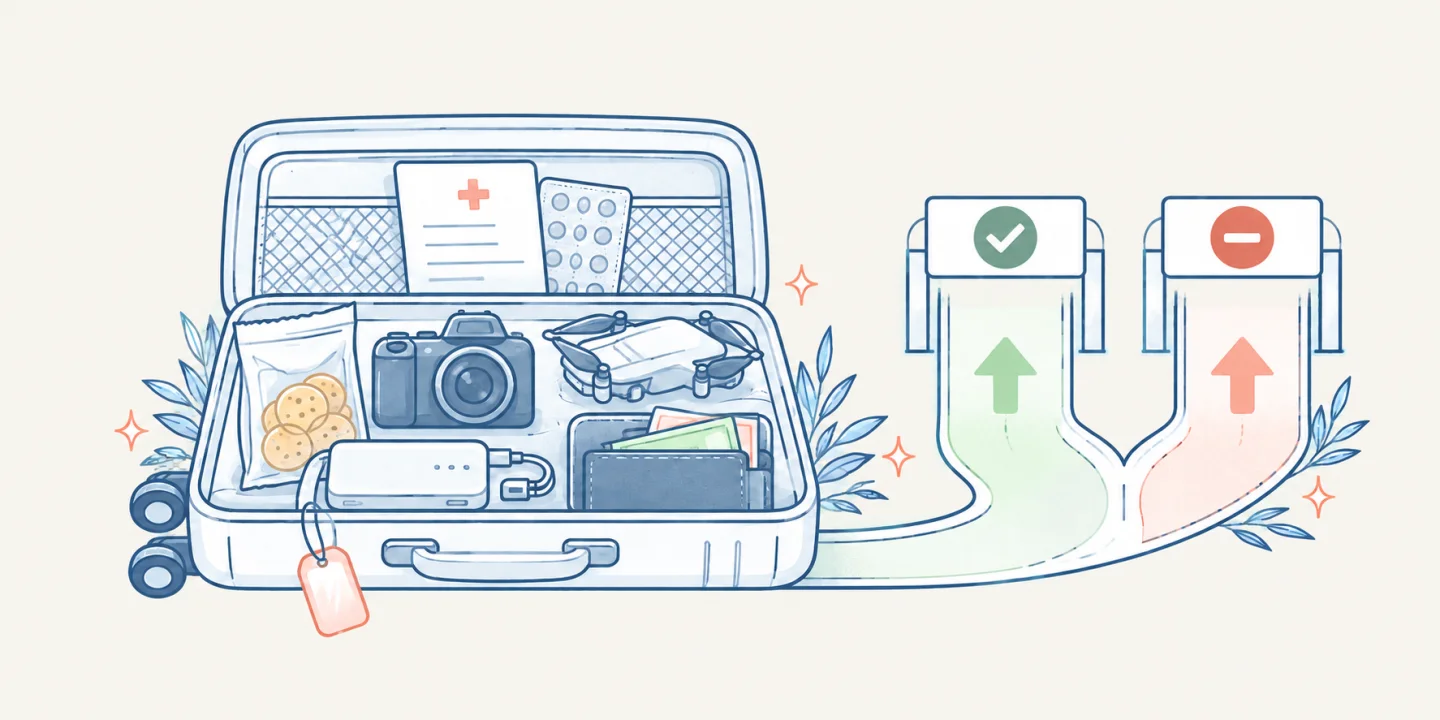
Decide before you reach the channel: identify uncertain items, keep evidence in carry-on baggage, and declare when required or in doubt.
What travelers must declare
China's 2025 passenger-baggage rules require an arriving traveler to submit a truthful paper or electronic declaration when carrying categories such as:
- prohibited goods;
- restricted goods above a limit or requiring a permit;
- animals, plants, animal or plant products, and other quarantine items;
- human tissue, blood, microorganisms, biological products, or items presenting a public-health risk;
- cash at or above the applicable declaration threshold;
- goods above duty-free or quantity allowances;
- commercial goods, samples, or advertising material;
- unaccompanied baggage;
- other items that legally require written declaration.
The full categories are set out in General Administration of Customs Announcement No. 43 of 2025, effective from 1 April 2025.
Red channel or green channel?
| Choose | When it fits | What to have ready |
|---|---|---|
| Green channel | You have no item requiring declaration | Your baggage must still be available for inspection |
| Red channel | You have a declarable item, excess quantity, permit, commercial sample, unaccompanied baggage, or genuine uncertainty | Declaration, passport, prescription, permit, invoice, or other supporting evidence |
Choosing green does not prevent an inspection. If Customs seals an item or bag, do not remove or break the seal without authorization.
Keep any Customs-endorsed declaration until the relevant goods or cash have left China. Put supporting documents in carry-on baggage rather than in a checked case you cannot reach during inspection.
How the electronic declaration works
Travelers can enter passenger-baggage information in advance through the Customs Pocket Declaration service in WeChat or Alipay, or through the official web declaration service.
Pre-filling is not the final release. On arrival or departure, confirm the data at the designated place and allow Customs to inspect the declaration and baggage. Use only an official channel when entering passport, itinerary, or item information.
The Customs service hotline is 12360.
Medicines: prepare the ingredient evidence
Small quantities of medicines that do not contain narcotic or psychotropic substances are generally assessed under the principles of personal use, reasonable quantity, and Customs supervision. That is not a blanket approval for every product or ingredient.
Carry:
- medicine in its original labeled packaging;
- a current prescription;
- a clinician's letter, medical record, or diagnosis certificate;
- the generic name and active ingredient;
- the strength, daily dose, and amount carried;
- a translation when the original evidence will not be understandable to the inspecting authority.
Do not rely on a brand name. Cold, pain, sleep, ADHD, anxiety, and traditional medicines can contain ingredients classified differently in China.
Medicines containing narcotic or psychotropic substances need individual checking. Official 2026 Chongqing Customs guidance explains that certain medicines required for treatment may be carried up to the permitted prescription quantity when the traveler presents diagnosis and identity evidence, subject to the category rules and on-site Customs review. It also advises travelers to bring supporting medical documents and declare proactively.
Contact the Chinese embassy or consulate and 12360 before departure when an active ingredient may be controlled. Medicines that require refrigeration, biological products, or blood products can also have health-quarantine and airline requirements.
Food, plants, and animal products
Food is not a single duty-free category. Quarantine rules can apply even when an item is commercially packaged, vacuum sealed, cooked, or intended as a gift.
Items that commonly require checking include:
- fresh fruit and vegetables;
- meat and meat products;
- eggs and some dairy products;
- seeds, live plants, bulbs, and soil;
- fresh or dried animal products;
- homemade food with unclear ingredients;
- products from an area subject to a disease-related restriction.
Identify every ingredient and the country of origin. A sealed bag of meat, fruit, seeds, or another animal or plant product can still be restricted or require quarantine review. Do not hide food inside checked baggage; declare it when required or uncertain.
Restrictions can respond to animal, plant, or public-health conditions and therefore change faster than general travel advice. Check the current item and origin close to departure.
Phones, laptops, cameras, and professional equipment
Ordinary personal electronics used during a trip will often fit the personal-use and reasonable-quantity principle. The risk changes when you carry:
- several new devices in retail packaging;
- goods intended for sale or substantial gifts;
- commercial samples;
- high-value professional production equipment;
- radio transmitters or communications-security equipment;
- equipment that will remain in China;
- electronics arriving separately as unaccompanied baggage.
The official Customs Clearance Guide for International Passengers lists commercial goods, samples, radio equipment, unaccompanied baggage, and certain high-value items among declaration situations.
For expensive equipment that will leave China with you, ask Customs whether a temporary entry declaration is appropriate. Keep serial numbers, purchase evidence, and any endorsed form so you can show that the same equipment is being re-exported.
Customs clearance does not override separate rules on radio transmission, encryption, mapping, photography, data, or professional activity.
Drones: entry and flight are separate decisions
Ask two different questions:
- May the drone, controller, and batteries pass through Customs and airline security?
- May this owner register, activate, and legally fly this model at the intended place?
China's national interim regulation on unmanned-aircraft flight management covers registration, controlled airspace, operating responsibilities, and other flight requirements. Airports and their surroundings, borders, military or sensitive sites, important infrastructure, and other designated areas may be controlled.
The Civil Aviation Administration of China announced that mandatory national standards for real-name registration, activation, and operational identification took effect on 1 May 2026. See the CAAC standards announcement.
Local rules can be more restrictive. Before bringing a drone, verify the current registration and activation route for the exact model and owner, check official airspace information and local notices, obtain any required approval, and confirm the airline's lithium-battery rules. If you cannot verify a lawful flight, do not fly.
Cash and negotiable instruments
The official Customs passenger guide lists RMB 20,000 cash or above and foreign-currency cash equivalent to USD 5,000 or above among the items for the red channel. Exchange-control handling and outbound documentation can depend on whether foreign cash was declared on entry and whether bank or foreign-exchange documents are available.
Practical approach:
- when you are at or near a threshold, use the red channel and ask;
- declare qualifying cash truthfully rather than dividing it between bags;
- retain the endorsed entry declaration if you expect to take the same foreign cash out again;
- remember that a bank-card credit limit is not physical cash;
- ask about travelers' checks, securities, or other negotiable instruments separately.
Currency conversion can move a borderline foreign-cash amount across a threshold. Leave a margin or declare.
Gifts, goods to leave in China, and commercial samples
An item used during your trip is not treated the same way as stock for sale, advertising material, or goods that will remain in China. Quantity, packaging, value, and intended use all affect the assessment.
Prepare invoices and a plain explanation of who owns the items and what will happen to them. Do not label commercial samples as personal effects to avoid a declaration.
Duty-free treatment and permission to import are different questions: an item can be allowed but taxable, restricted pending a permit, or prohibited regardless of value.
Hong Kong and Macao crossings
Hong Kong and Macao are separate customs territories. Traveling from either place into Mainland China is a Customs entry to the Mainland; traveling in the other direction is an exit. The rule applies whether the crossing is by high-speed rail, ferry, bridge, or air.
Recheck allowances and restrictions each time your itinerary crosses one of those customs boundaries.
Before departure: five-minute customs check
- List medicines, food, plant or animal products, high-value equipment, drones, cash, and goods you will leave behind.
- Check each uncertain item in the Customs Item Checker.
- Verify any uncertain or time-sensitive result through an official source or 12360.
- Save prescriptions, permits, invoices, and serial numbers offline.
- Pack evidence in carry-on baggage and use the red channel when declaration is required or classification remains uncertain.
Common questions
Does electronic pre-filing mean I can walk through the green channel?
No. The official process requires confirmation at the designated place and remains subject to Customs verification.
Is packaged food automatically allowed?
No. Packaging does not remove animal, plant, disease-control, or ingredient restrictions.
Is a personal prescription enough for every medicine?
No. The active ingredient, medicine category, quantity, and supporting evidence matter, and final clearance is decided by Customs.
If Customs releases my drone, may I fly it?
Not necessarily. Aircraft registration, activation, airspace, local rules, and operating permissions are separate from Customs clearance.
What should I do when an old travel blog conflicts with current Customs guidance?
Use the current official rule and ask 12360 when your facts remain unclear.
Official sources
- GACC Announcement No. 43 of 2025 on passenger-baggage declarations
- China Customs: Customs Clearance Guide for International Passengers
- Official passenger-goods declaration service
- Chongqing Customs: medicines for personal use
- State Council: Interim Regulation on the Flight Administration of Unmanned Aircraft
- Civil Aviation Administration: 2026 UAV registration and activation standards
Last verified: 8 September 2026. Customs clearance, duty, permits, medicine classification, and drone flight authorization are fact-specific; ask the responsible authority when your item or use case is uncertain.